What to do about a gambling complaint or disputed withdrawal
 Available in GB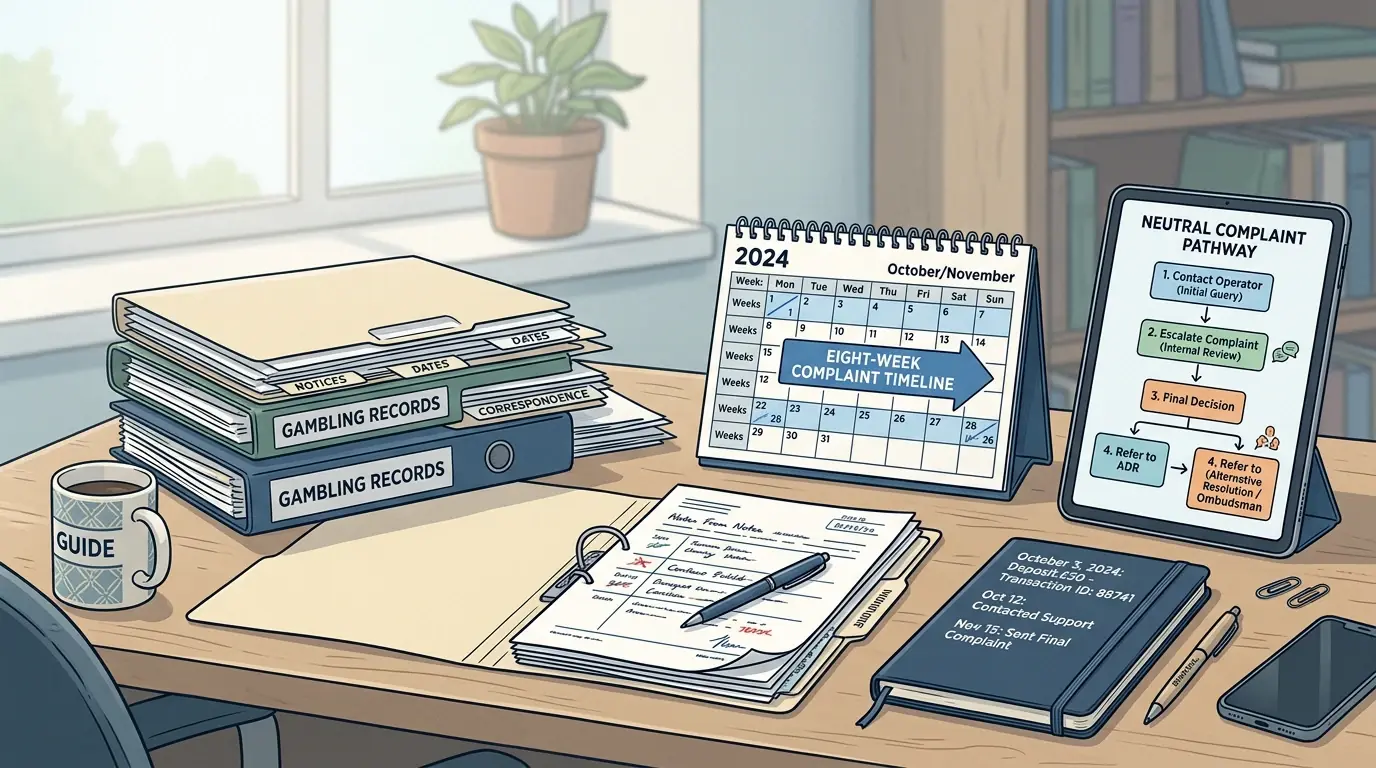
Table of Contents
- First question: is the business licensed for Great Britain?
- The licensed-operator complaint route in plain English
- Step-by-step complaint sequence
- Common complaint types and what evidence helps
- Top online casinos in the UK
- Limits when the site is not on the Great Britain register
- What a clear complaint message can include
- Where to go next
First question: is the business licensed for Great Britain?
The complaint route is very different depending on whether the gambling business is licensed by the Gambling Commission. For a business serving Great Britain consumers, the official public register is the place to check licence status, trading names and domains. A foreign licence badge, a company name in another country or a polished complaints page does not replace that check.
If the business is licensed, there is a clearer route: raise the complaint with the operator first, give the process time to run, and understand when alternative dispute resolution may be available. If the business is not on the register, expectations should be more cautious. The Gambling Commission may use information about illegal gambling, but it does not become a private claims handler for every individual dispute, and an offshore-only site may leave the customer with far fewer practical options.
That is why licence status should be checked before a deposit, not only after a dispute. Once money is already in an account, the customer’s leverage may depend heavily on the terms, the business’s location, the payment route and whether a recognised complaint pathway exists.
The licensed-operator complaint route in plain English
For licensed gambling businesses, the official route starts with the operator’s own complaint process. The complaint should describe the issue clearly, include enough evidence to identify the account and transaction, and say what outcome is being requested. It should not be a stream of angry messages across different channels; that makes it harder to track and easier for important details to be missed.
If the operator does not resolve the complaint, or if the answer is unsatisfactory after eight weeks, alternative dispute resolution may be relevant. ADR is not a shortcut for every disagreement and it does not guarantee the outcome the customer wants. Its role is to handle eligible disputes under a defined process. A useful public guide should explain that route without naming a likely result, predicting compensation or giving legal advice.
Some issues are also not the same thing as a complaint about a gambling outcome. For example, a request for age or identity verification can be part of a regulated process. A disagreement about how terms were applied may need the exact wording of those terms. A delayed withdrawal may involve checks that are permitted, but the business should still communicate clearly. The complaint should therefore focus on facts: what happened, when it happened, what rule or message is being relied on, and why the customer believes the outcome is wrong.
Step-by-step complaint sequence
- Stop adding new money to the account while the issue is unresolved. A dispute is already enough uncertainty. More deposits can make the record harder to follow and increase stress.
- Save the account record. Keep the balance shown, transaction IDs, deposit dates, withdrawal requests, screenshots of relevant terms, identity requests and all messages from the operator.
- Check the register. Confirm whether the business appears on the Gambling Commission public register and whether the domain and trading name match.
- Use the operator’s complaint process. Label the message as a complaint if the terms require it, give a short timeline and attach only relevant evidence.
- Ask for the exact reason in writing. If a withdrawal is refused, ask which term, check or account decision is being used. Do not rely on vague chat statements.
- Mark the dates. For a licensed operator, ADR may become relevant if the complaint is unresolved or unsatisfactory after eight weeks.
- Keep expectations realistic. ADR, regulators and banks have boundaries. None should be presented as a guaranteed way to recover funds.
Common complaint types and what evidence helps
| Issue | Useful evidence | Why it matters |
|---|---|---|
| Delayed withdrawal | Withdrawal request date, amount, status messages, verification requests and account balance screenshots. | It shows whether the delay is connected to identity review, payment checks, bonus terms or lack of response. |
| Voided winnings | Terms in force at the time, bonus conditions, game history if available and the operator’s explanation. | The dispute often turns on the wording applied and whether the customer was clearly told about it. |
| Account closure | Closure notice, balance, pending withdrawals, relevant terms and any prior document requests. | It helps separate a security review from a disagreement about funds or terms. |
| Identity or age check dispute | What was requested, how it was submitted, when it was submitted and the reason for rejection. | Licensed online businesses must verify age and identity, but the process should still be explainable. |
| Customer funds concern | Terms describing customer-fund protection and any statements about insolvency protection. | Customer funds are not automatically protected if the business fails, so the exact protection wording matters. |
Top online casinos in the UK
- x3betBonus: Welcome Pack 100% Up to £1.000 + 200 Free Spins · Payout speed: 1-3 business days
- SpinFormulaBonus: 550% Up To £15,000 + 550 FS · Payout speed: 1-3 business days
- NightWinBonus: £900 + 400 free spins · Payout speed: 1-3 business days
- BritsinoBonus: Welcome Package – Get your £2,200 + 2,000 FS · Payout speed: 1-3 business days
- JetsetspinsBonus: 200% Bonus + 100 Free Spins + Free Royal Wheel · Payout speed: 1-3 business days
- ChanzeBonus: Slots Welcome Bonus #1 200% up to €500 · Payout speed: 1-3 business days
Limits when the site is not on the Great Britain register
When a site is not on the Gambling Commission register, the customer may still be able to complain to the business, but the protections and escalation routes may be much weaker. An overseas licence may have its own rules, but it should not be described as equivalent to a Great Britain licence unless that claim is properly supported. A customer should not assume that an overseas regulator, a payment provider, a bank or a forum will be able to settle the dispute.
This is where a practical guide has to be honest. It can tell the reader to keep records, stop depositing, avoid threats, check whether the business is registered, and use any written complaint process available. It should not promise chargebacks, compensation, criminal action or legal remedies. Those outcomes depend on facts that cannot be known from a generic page.
It is also important not to turn a dispute into repeated gambling. Chasing a withdrawal, reopening accounts, using new payment routes or continuing to play while angry can create more risk. If the problem is causing stress or repeated attempts to win back losses, the safer next step may be to use support and blocking tools rather than focusing only on the complaint.
What a clear complaint message can include
The example above shows the tone that usually helps: factual, short and focused on evidence. It should be adapted only with real account details that the customer can prove. Do not include insults, threats or claims that cannot be proved. The aim is to create a record that another reviewer can understand later.
Where to go next
If the first question is licence status, use the Gambling Commission register guide. If the issue is mainly identity checks, payment blocks or withdrawal friction, read payments, identity checks and withdrawals. If the complaint is linked to pressure, chasing losses or difficulty stopping, the page on GAMSTOP, bank blocks and support options is the better next step.
Learn how to secure your payout process on the landing page.
Ensure a smooth payout procedure by knowing the deposit and withdrawal requirements.
Created by the "Casino not on Gamstop" editorial team.