
Risk signals to check before depositing at any gambling site
 Available in GB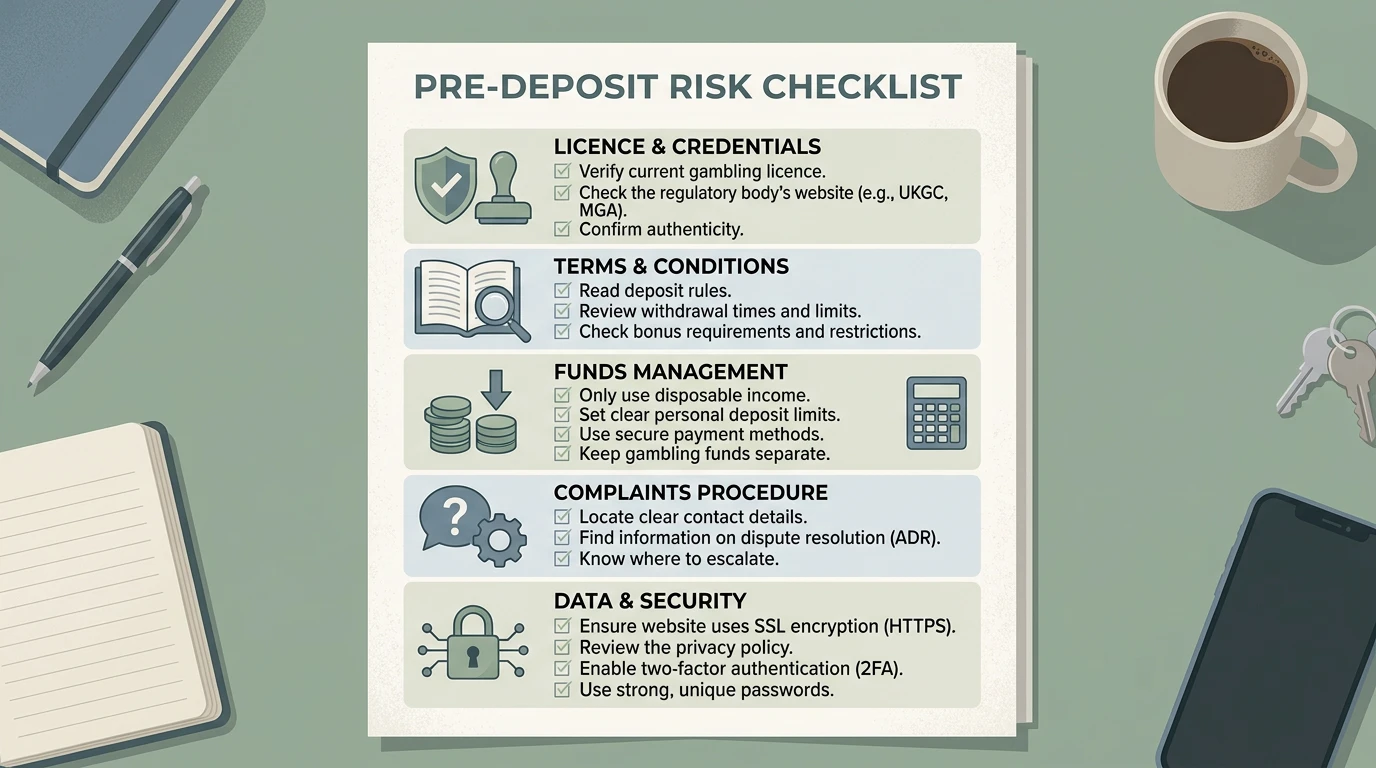
Table of Contents
- Start with what can be verified
- Pre-deposit checklist
- Top online casinos in the UK
- Licence evidence is the foundation, not the whole decision
- Money and withdrawal warning signs
- Complaint route and records
- Data, privacy and identity checks
- Promotion wording that deserves caution
- A simple decision path
- Where to go next
Start with what can be verified
The first check is whether the gambling business can be found on the Gambling Commission public register when it is serving Great Britain consumers. A visible logo, overseas badge or confident claim is not enough by itself. The business name, trading name and domain should make sense when compared with the official record. If that link is unclear, do not treat the site as checked.
This matters because other decisions depend on licence status. Complaint routes, advertising responsibilities, customer-fund information and many expectations around fair treatment are easier to understand when the business is inside the Great Britain regulatory framework. If the site appears to sit outside it, the reader should avoid assuming that familiar protections or escalation routes will apply.
Pre-deposit checklist
| Check | What clear information looks like | Why a gap matters |
|---|---|---|
| Licence evidence | The business name, trading name and domain can be compared with the official register. | A badge without a match does not prove Great Britain licence coverage. |
| Terms and withdrawals | Withdrawal rules, verification points, bonus conditions and account restrictions are visible before deposit. | Unclear terms often become important only when a player tries to withdraw. |
| Customer funds | The site explains what protection, if any, applies to customer money if the business fails. | Licensed businesses must tell customers about fund protection, but funds are not automatically protected. |
| Complaint route | The site explains how to complain and how unresolved licensed-operator complaints may be escalated. | A missing route can leave the reader with fewer practical options after a dispute. |
| Data and identity | The privacy information and verification expectations are easy to find and written clearly. | Document requests and data handling should not be a surprise after money is trapped in an account. |
| Promotional wording | Bonus conditions, wagering rules and limits are close to the offer and not hidden. | Claims that feel risk-free, urgent or too simple may hide restrictions that affect withdrawals. |
Top online casinos in the UK
- x3betBonus: Welcome Pack 100% Up to £1.000 + 200 Free Spins · Payout speed: 1-3 business days
- SpinFormulaBonus: 550% Up To £15,000 + 550 FS · Payout speed: 1-3 business days
- NightWinBonus: £900 + 400 free spins · Payout speed: 1-3 business days
- BritsinoBonus: Welcome Package – Get your £2,200 + 2,000 FS · Payout speed: 1-3 business days
- JetsetspinsBonus: 200% Bonus + 100 Free Spins + Free Royal Wheel · Payout speed: 1-3 business days
- ChanzeBonus: Slots Welcome Bonus #1 200% up to €500 · Payout speed: 1-3 business days
Licence evidence is the foundation, not the whole decision
A confirmed Great Britain licence is important, but it does not make every offer suitable or every gambling decision sensible. It is the starting point for understanding which framework applies. After that, the reader still needs to look at the product, the terms and their own situation. If a person is self-excluded, chasing a site outside a block should be treated as a personal risk signal even before commercial details are considered.
On the other side, a missing or unclear register match is not something to explain away because the site looks professional. Professional design, live chat, large promotional numbers and a long terms page can all exist without answering the key question. If the identity of the business is not clear, the rest of the checks become weaker.
Money and withdrawal warning signs
Withdrawal problems often arise from a mismatch between what the reader expected and what the terms allow. A site may require identity checks, payment checks or other information before withdrawal, even if the account felt quick to open. That is why “fast cashout” claims should be read together with verification rules, maximum withdrawal limits, bonus conditions and account-review wording. If those sections are hard to find, vague or contradictory, do not assume the quickest interpretation will apply.
Customer funds also deserve a separate check. Licensed operators must tell customers what level of protection applies to customer money, but customer balances are not automatically protected if a business fails. The wording can vary, so it should be read before deposit rather than discovered after a problem. A reader should avoid keeping more money in an account than they can afford to have delayed or put at risk.
Complaint route and records
For licensed gambling businesses, the normal complaint route starts with the business. If the complaint is unresolved or the response is unsatisfactory after the relevant period, alternative dispute resolution may be available. That route has boundaries: it is not a promise that every complaint will be won, and it may not help where the business is not licensed for Great Britain or where the issue sits outside the scheme’s scope.
Good records help whatever the route is. Before depositing, note the terms that apply to any offer, the withdrawal rules, the account name, the date and the business details. After a problem, keep copies of chat messages, emails, account notices and transaction records. Do not edit screenshots in a way that makes the sequence unclear. The goal is a clean record of what was said and when.
Data, privacy and identity checks
Gambling accounts can involve sensitive information: identity documents, payment data, addresses, betting history and sometimes financial information. UK data-protection rights can be explained at a general level, but the details of how one site handles data depend on its own privacy notice and the law that applies to it. If a privacy notice is missing, generic, hard to understand or inconsistent with the company details, that is a serious reason to pause.
Be careful with claims that make document checks sound unnecessary. A promise of “no verification” may be attractive to someone who wants speed, but it may also be unrealistic or unsafe. If checks are delayed until withdrawal, the reader could find that money is inaccessible while documents are reviewed. The safer approach is to understand identity expectations before the first deposit.
Promotion wording that deserves caution
- Risk-free language. Gambling is not risk-free, and promotional wording should not make loss sound impossible or trivial.
- Very large headline numbers. A large bonus figure is not useful until wagering rules, eligible games, time limits and withdrawal caps are clear.
- Urgency pressure. “Only today” language can push a reader to skip checks that should come first.
- Guaranteed payout claims. A payout promise does not remove verification, terms or the need to understand licence status.
- Support-block avoidance. Wording that makes self-exclusion or bank blocks sound like obstacles to beat should be treated as a harm signal.
A simple decision path
- If the official licence details do not match, stop and do not rely on the site’s own claim.
- If withdrawal, bonus or verification terms are unclear, do not deposit until they are clear in writing.
- If customer-fund protection is not explained, treat your balance as exposed to extra uncertainty.
- If the complaint route is missing or only points to informal support, consider how limited your options may be after a dispute.
- If you are trying to gamble despite self-exclusion, a bank block or loss of control, step away from the commercial decision and use support tools instead.
Where to go next
For the official licence workflow, read how to check a gambling site on the Gambling Commission register. For payment and verification concerns, read payments, identity checks and withdrawals. If a dispute has already started, read complaints and disputes. If the reason for looking is self-exclusion, a bank gambling block or difficulty stopping, read control tools and support before making another gambling decision.
Ensure you are playing only on safe and authorized sites reviewed on the homepage.
Double-check any operator claims by learning how to verify an operator on the Gambling Commission register.
Created by the "Casino not on Gamstop" editorial team.